


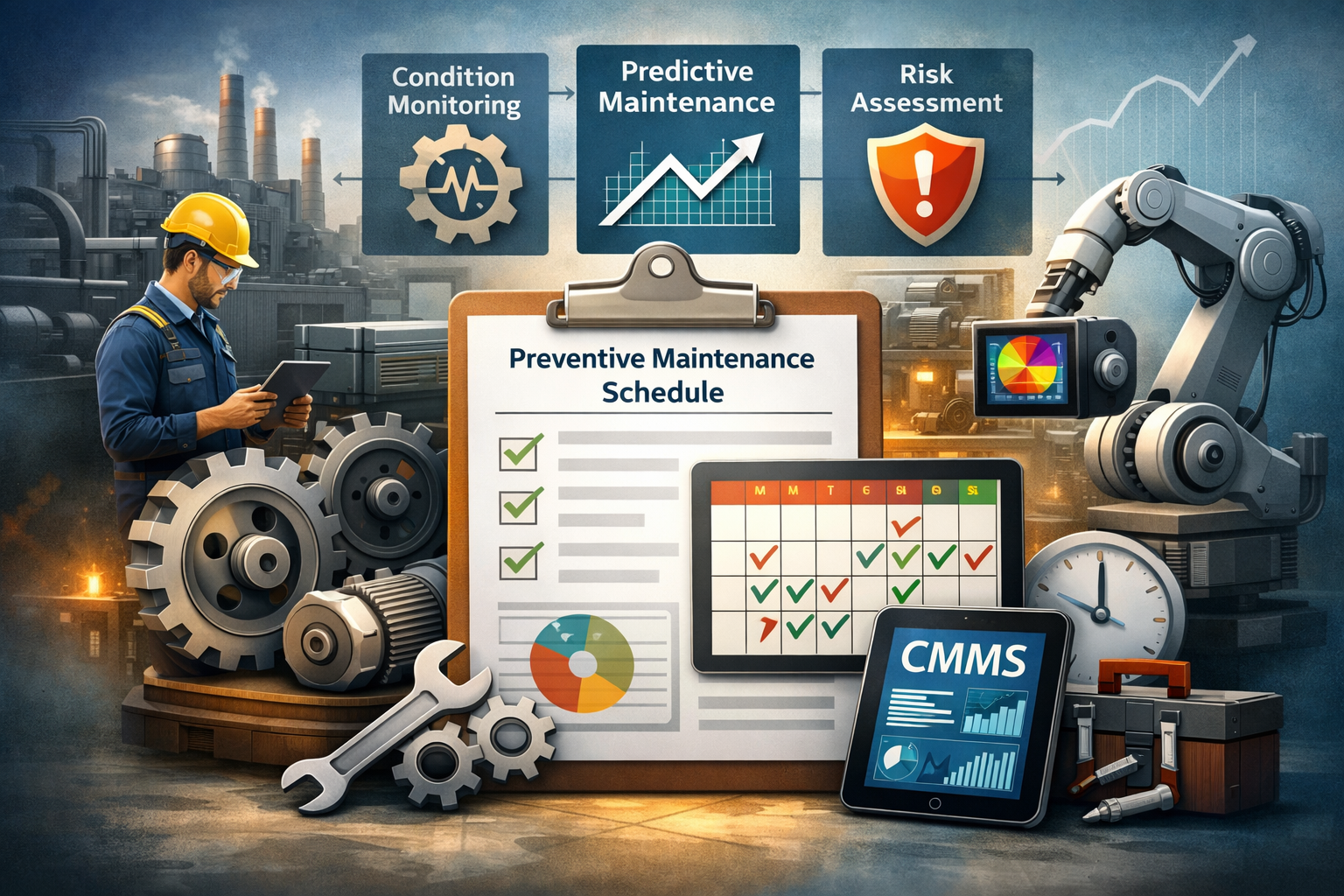
Introduction: Why Preventive Maintenance Still Fails in Many Organizations
For a long time, organizations have viewed preventive maintenance (PM) as the remedy for costly equipment failures and operational disruptions. However, many businesses find it difficult to create truly effective maintenance programs. Poorly drafted schedules that fail to reflect actual operating conditions often cause the problem, rather than a lack of purpose. All too frequently, maintenance plans are either too broad or too strict, which leads to overlooked failures or resource waste. Instead of being a static checklist, a well-designed preventive maintenance program should function as a dynamic system. It must change in response to company priorities, consumption trends, and asset performance. The first step to creating a schedule that truly works is to comprehend this distinction.
Understanding Asset Criticality and Risk-Based Prioritization
Understanding asset criticality is the cornerstone of any effective preventive maintenance program. Equipment does not all require the same level of care, and doing so results in inefficiencies. Critical assets—those that directly affect revenue, safety, or compliance—should receive more frequent and thorough maintenance. Organizations can better allocate resources where they are most needed by using a risk-based approach. This entails assessing the possibility of failure as well as its effects. A production-line motor and a small HVAC unit, for instance, shouldn’t have the same maintenance schedule. Organizations can minimize downtime while maximizing labor and cost by ranking assets according to risk.
Moving Beyond Time-Based Scheduling
Time-based intervals, like weekly or monthly checks, are frequently used in traditional preventative maintenance. Although this method is easy to apply, it does not take into consideration the actual use or condition of the assets. Usage-based and condition-based scheduling are becoming more and more popular in modern maintenance tactics. For example, machinery that is utilized sporadically may need less frequent maintenance than equipment that is used continuously. In a similar vein, real-time asset health monitoring is now possible thanks to sensors and IoT technologies. Instead of acting after arbitrary time intervals, maintenance teams can take action prior to breakdowns thanks to this data. More accurate and economical maintenance procedures result from going beyond time-based scheduling.
Leveraging Data and CMMS for Smarter Scheduling
In order to create a preventative maintenance program that changes and gets better over time, data is essential. The foundation of this endeavor can be a Computerized Maintenance Management System (CMMS). A CMMS facilitates well-informed decision-making by gathering historical maintenance data, failure trends, and asset performance measures. Businesses are able to recognize reoccurring problems and modify maintenance schedules appropriately. For instance, teams can shorten the interval if a component often fails just before its scheduled service. On the other hand, they can optimize maintenance frequency to save resources when an asset rarely shows problems. Preventive maintenance is no longer a guessing but rather a strategic role thanks to data-driven scheduling.
Balancing Preventive and Predictive Maintenance Approaches
Preventive maintenance is not the only component of an efficient maintenance plan. Rather, where practical, it incorporates predictive maintenance methods. Predictive maintenance forecasts failures before they happen by using machine learning, advanced analytics, and sensors. Even partial deployment of predictive technology can improve preventive schedules, even though not all organizations can fully employ them. For instance, thermal imaging or vibration analysis can spot early indicators of wear in vital equipment. This prevents both premature servicing and unplanned breakdowns by enabling maintenance crews to step in at the appropriate moment. A well-rounded strategy guarantees proactive and accurate maintenance.
Overcoming Common Implementation Challenges
Despite its advantages, creating and upholding a successful preventative maintenance schedule is not without its difficulties. Resistance from technicians who might see new procedures as disruptive is one frequent problem. To guarantee team buy-in, training and clear communication are crucial. Data quality presents another difficulty since insufficient or erroneous data can result in poor scheduling choices. Businesses need to spend money on appropriate procedures for gathering and validating data. Furthermore, excessive service can result in unneeded expenses and even equipment wear, making it a hidden issue. Such inefficiencies can be found and fixed with the aid of routine maintenance schedule audits. Long-term success is ensured by aggressively addressing these issues.
Aligning Maintenance with Business Goals
Preventive maintenance shouldn’t function independently of more general company goals. Rather, it should be in line with company objectives including customer pleasure, safety compliance, and cost reduction. For example, in industries where uptime directly impacts revenue, maintenance schedules should prioritize avoiding disruptions. In regulated industries, compliance requirements may mandate specific maintenance tasks and intervals. In order to achieve this alignment, cooperation between maintenance teams and other departments is essential. Maintenance initiatives receive more organizational support and visibility when they align with business objectives. Maintenance becomes a value driver instead of a cost center as a result of this alignment.
Continuous Improvement: The Key to Long-Term Success
A preventive maintenance program is a continuous practice rather than a one-time undertaking. Maintaining the schedule’s effectiveness and relevance requires constant improvement. This entails routinely examining performance indicators like maintenance expenses and mean time between failures (MTBF). Technician feedback can also offer insightful information about what works and what doesn’t. Businesses should set up a feedback loop so that information and experience can guide future changes. This iterative process eventually results in a maintenance strategy that is more sophisticated and effective. The timetable is kept up to date with evolving operational conditions thanks to continuous development.
Conclusion: Building a System That Evolves with Your Operations
It takes more than just assigning regular duties to create an effective preventative maintenance schedule. It necessitates a careful, data-driven strategy that takes organizational objectives, usage trends, and asset criticality into account. Organizations can develop maintenance schedules that are resilient and effective by eschewing conventional approaches and adopting contemporary technologies and techniques. The most successful schedules are those that change over time in response to data and ongoing development. Preventive maintenance improves overall operational performance and lowers downtime when done correctly. In the end, it stops being a regular duty and instead becomes a strategic advantage.

Introduction: Why Preventive Maintenance Still Fails in Many Organizations
For a long time, organizations have viewed preventive maintenance (PM) as the remedy for costly equipment failures and operational disruptions. However, many businesses find it difficult to create truly effective maintenance programs. Poorly drafted schedules that fail to reflect actual operating conditions often cause the problem, rather than a lack of purpose. All too frequently, maintenance plans are either too broad or too strict, which leads to overlooked failures or resource waste. Instead of being a static checklist, a well-designed preventive maintenance program should function as a dynamic system. It must change in response to company priorities, consumption trends, and asset performance. The first step to creating a schedule that truly works is to comprehend this distinction.
Understanding Asset Criticality and Risk-Based Prioritization
Understanding asset criticality is the cornerstone of any effective preventive maintenance program. Equipment does not all require the same level of care, and doing so results in inefficiencies. Critical assets—those that directly affect revenue, safety, or compliance—should receive more frequent and thorough maintenance. Organizations can better allocate resources where they are most needed by using a risk-based approach. This entails assessing the possibility of failure as well as its effects. A production-line motor and a small HVAC unit, for instance, shouldn’t have the same maintenance schedule. Organizations can minimize downtime while maximizing labor and cost by ranking assets according to risk.
Moving Beyond Time-Based Scheduling
Time-based intervals, like weekly or monthly checks, are frequently used in traditional preventative maintenance. Although this method is easy to apply, it does not take into consideration the actual use or condition of the assets. Usage-based and condition-based scheduling are becoming more and more popular in modern maintenance tactics. For example, machinery that is utilized sporadically may need less frequent maintenance than equipment that is used continuously. In a similar vein, real-time asset health monitoring is now possible thanks to sensors and IoT technologies. Instead of acting after arbitrary time intervals, maintenance teams can take action prior to breakdowns thanks to this data. More accurate and economical maintenance procedures result from going beyond time-based scheduling.
Leveraging Data and CMMS for Smarter Scheduling
In order to create a preventative maintenance program that changes and gets better over time, data is essential. The foundation of this endeavor can be a Computerized Maintenance Management System (CMMS). A CMMS facilitates well-informed decision-making by gathering historical maintenance data, failure trends, and asset performance measures. Businesses are able to recognize reoccurring problems and modify maintenance schedules appropriately. For instance, teams can shorten the interval if a component often fails just before its scheduled service. On the other hand, they can optimize maintenance frequency to save resources when an asset rarely shows problems. Preventive maintenance is no longer a guessing but rather a strategic role thanks to data-driven scheduling.
Balancing Preventive and Predictive Maintenance Approaches
Preventive maintenance is not the only component of an efficient maintenance plan. Rather, where practical, it incorporates predictive maintenance methods. Predictive maintenance forecasts failures before they happen by using machine learning, advanced analytics, and sensors. Even partial deployment of predictive technology can improve preventive schedules, even though not all organizations can fully employ them. For instance, thermal imaging or vibration analysis can spot early indicators of wear in vital equipment. This prevents both premature servicing and unplanned breakdowns by enabling maintenance crews to step in at the appropriate moment. A well-rounded strategy guarantees proactive and accurate maintenance.
Overcoming Common Implementation Challenges
Despite its advantages, creating and upholding a successful preventative maintenance schedule is not without its difficulties. Resistance from technicians who might see new procedures as disruptive is one frequent problem. To guarantee team buy-in, training and clear communication are crucial. Data quality presents another difficulty since insufficient or erroneous data can result in poor scheduling choices. Businesses need to spend money on appropriate procedures for gathering and validating data. Furthermore, excessive service can result in unneeded expenses and even equipment wear, making it a hidden issue. Such inefficiencies can be found and fixed with the aid of routine maintenance schedule audits. Long-term success is ensured by aggressively addressing these issues.
Aligning Maintenance with Business Goals
Preventive maintenance shouldn’t function independently of more general company goals. Rather, it should be in line with company objectives including customer pleasure, safety compliance, and cost reduction. For example, in industries where uptime directly impacts revenue, maintenance schedules should prioritize avoiding disruptions. In regulated industries, compliance requirements may mandate specific maintenance tasks and intervals. In order to achieve this alignment, cooperation between maintenance teams and other departments is essential. Maintenance initiatives receive more organizational support and visibility when they align with business objectives. Maintenance becomes a value driver instead of a cost center as a result of this alignment.
Continuous Improvement: The Key to Long-Term Success
A preventive maintenance program is a continuous practice rather than a one-time undertaking. Maintaining the schedule’s effectiveness and relevance requires constant improvement. This entails routinely examining performance indicators like maintenance expenses and mean time between failures (MTBF). Technician feedback can also offer insightful information about what works and what doesn’t. Businesses should set up a feedback loop so that information and experience can guide future changes. This iterative process eventually results in a maintenance strategy that is more sophisticated and effective. The timetable is kept up to date with evolving operational conditions thanks to continuous development.
Conclusion: Building a System That Evolves with Your Operations
It takes more than just assigning regular duties to create an effective preventative maintenance schedule. It necessitates a careful, data-driven strategy that takes organizational objectives, usage trends, and asset criticality into account. Organizations can develop maintenance schedules that are resilient and effective by eschewing conventional approaches and adopting contemporary technologies and techniques. The most successful schedules are those that change over time in response to data and ongoing development. Preventive maintenance improves overall operational performance and lowers downtime when done correctly. In the end, it stops being a regular duty and instead becomes a strategic advantage.